
A garage door that goes down a foot or two, stops, and climbs back up is one of the most common calls we get, and it is also one of the most misdiagnosed. The instinct is to blame the safety eyes at the bottom of the track. Sometimes that is right. Often it is not, and the actual cause is a travel limit, a force setting, or a mechanical bind that has been building for months. This article walks through what a homeowner can safely observe, what those observations point to, and where the work has to stop and a technician take over. It applies to standard sectional doors and to the tilt-up and single-panel doors common on older buildings around San Francisco.
First, separate the two kinds of reversal
Not every reversal is the same event, and the distinction matters. A door that reverses while it is closing, before it reaches the floor, is behaving in a way the safety system is designed to cause. A door that reverses before it starts moving, or that opens a little and then goes back up, is a different problem entirely. The photo-eye is a safety device on the down travel only. It has no role in a door that will not start, and it has no role in a door that opens a few inches and reverses. If your door is doing either of those, the eyes are probably not the answer, and adjusting them will not fix it.
The one case where the photo-eye is a certain cause is this: the door is closing, the beam between the two sensors is blocked or the sensors are out of alignment, and the door reverses while traveling down. That is the safety circuit doing its job. A cobweb, a leaf, a parked bicycle, a sagging sensor bracket, or a sensor that has been knocked out of line will all produce it. Clearing the path and checking that both sensors are square to each other is safe homeowner work.
What a travel-limit or force-setting fault looks like
If the door travels down and reverses before it reaches the floor, and nothing is in the beam path, the opener is most likely reading the door as meeting resistance and treating that as an obstruction. Two settings control this: the travel limit, which tells the opener where the closed position is, and the force setting, which tells it how much resistance to tolerate before reversing. Both drift over time. A door that used to close cleanly and now stops a few inches short, or reverses at the same spot every time, is a classic sign that the closed limit has moved or the force setting has become too sensitive.
There is one thing you can do yourself here, and it is diagnostic rather than a repair. Watch the door through a full cycle from a safe distance and note exactly where the reversal happens. Does it happen at the same point every time, or does it vary? A reversal at a consistent point suggests a limit setting or a physical obstruction at that spot. A reversal that happens at different heights suggests the force setting is marginal, or that something in the door's travel is binding intermittently. Either way, the adjustment itself belongs to a technician, because the force setting is a safety adjustment and setting it too high defeats the reverse mechanism.
When the cause is mechanical, not electronic
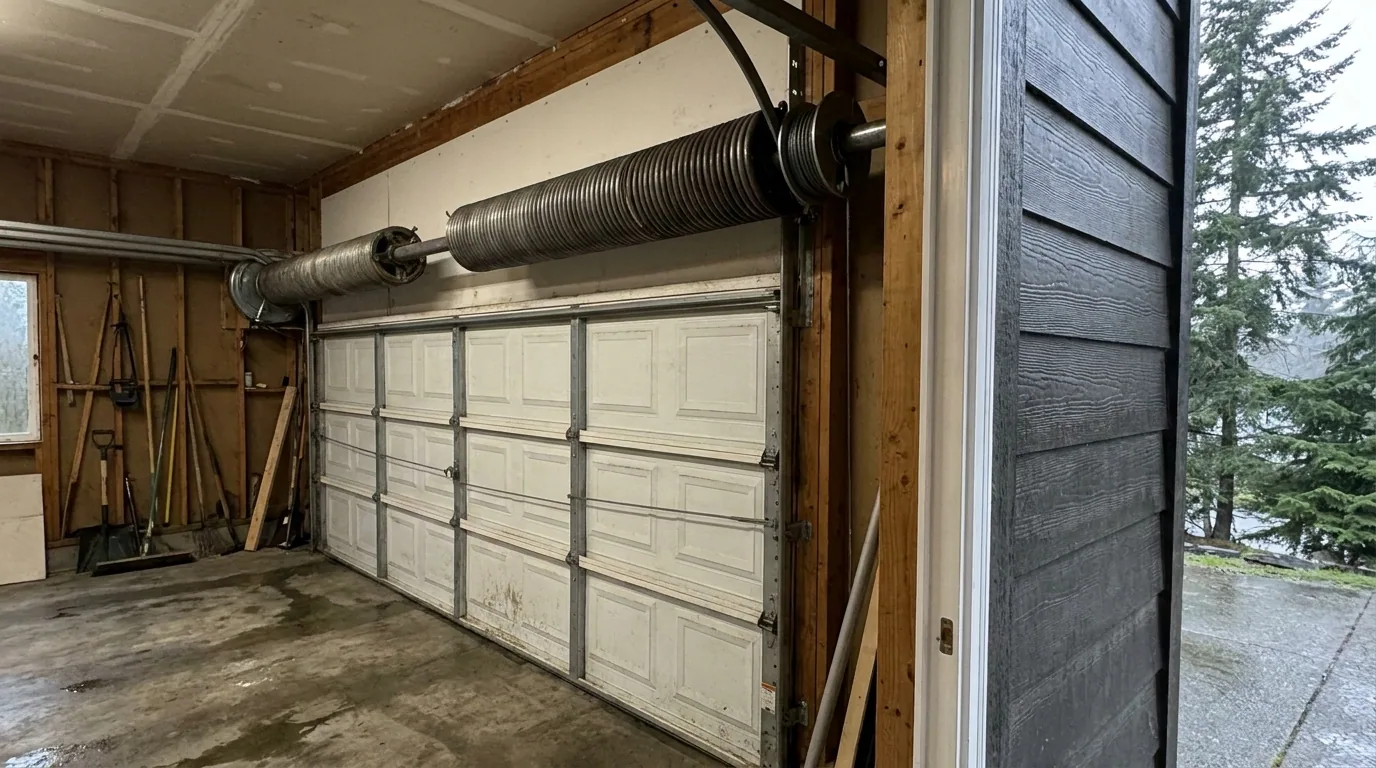
A door can also reverse because it is genuinely harder to move than it used to be. The opener is not wrong to reverse; it is responding to real resistance. Common mechanical causes include a roller that has seized or come out of its track, a hinge that has bent, a track that has been pushed out of alignment, or a cable that has jumped a drum. On older tilt-up and single-panel doors, a sagging header or a track that has shifted with the building can produce the same effect. In pre-1970 buildings the garage opening often carries structural load, so track and header damage deserves a careful look before anyone drills or forces anything back into place.
What you can observe from outside the door, with the garage empty and the door closed, is limited but useful. Does the door sit crooked in the opening? Is there a gap along the top or down one side that was not there before? Does the door feel heavier than usual when you use it normally? Is there a new noise at the start of the cycle, or a grinding sound partway down? None of these observations tells you which component is at fault, but they tell a technician where to start. The technician will inspect the springs, cables, rollers, hinges, and track, and will check the door's balance as part of the diagnosis.
What not to do
Do not reach for the springs, the cables, or the opener's drive train. Torsion springs are under high tension, and a cable that is under load can release suddenly. Do not pull the emergency release and try to move the door by hand to see whether it is balanced, and do not lift the door to feel its weight. Those are technician tests, and they are the ones most likely to cause injury when done by someone who is not trained to do them. Do not adjust the force setting upward to stop the reversing; that disables the safety feature that protects anyone standing under the door.
If the door is reversing and you cannot clear it by removing an obstruction from the photo-eye path, the right move is to leave the door in the open position if it will stay there, keep people and vehicles clear of it, and call for service. Same Day Garage Door Repair & Service is licensed and insured and serves homeowners, landlords, and small commercial property managers across San Francisco, including the Mission District, Castro, Noe Valley, Pacific Heights, SoMa, Richmond District, Sunset District, Bernal Heights, Glen Park, Marina District, North Beach, Hayes Valley, Potrero Hill, and Excelsior District. Reach us at (415) 992-9484 or SameDayGarageDoorOne@gmail.com. Weekday hours are 7:00 AM to 8:00 PM, weekend hours are 8:00 AM to 6:00 PM, and 24/7 emergency service is available.
A note on older doors and coastal buildings
Original timber doors on Victorians and Edwardians usually need adjustment rather than replacement, and a reversal that appears suddenly on a door that has worked for years is often a sign that something has shifted rather than failed. Exposed steel on doors in the Sunset, Richmond, and Marina districts is also more prone to corrosion, which can stiffen rollers and hinges over time and add resistance the opener reads as an obstruction. None of that changes the diagnosis: observe what you can from outside the door, clear the photo-eye path if the door is reversing on the way down, and route everything else to a technician who can inspect the springs, cables, and track safely.