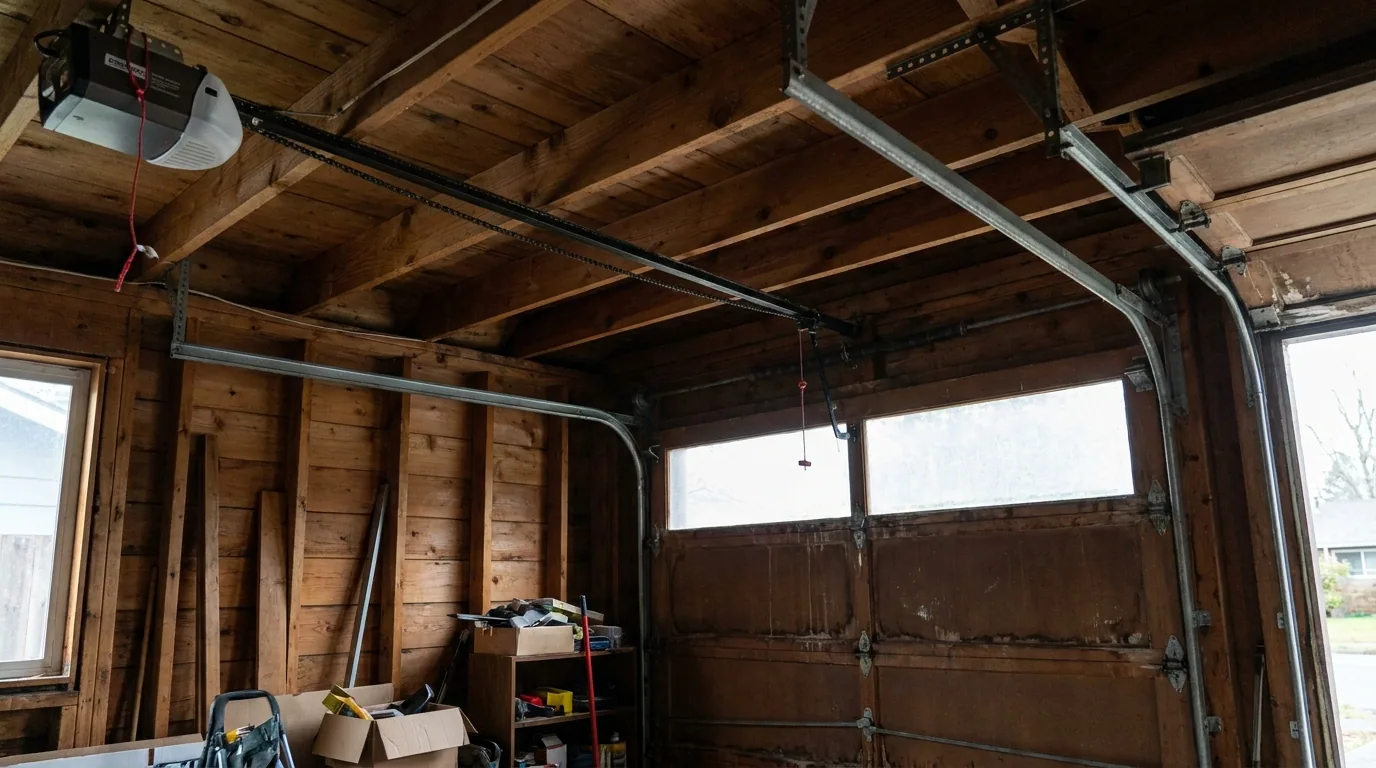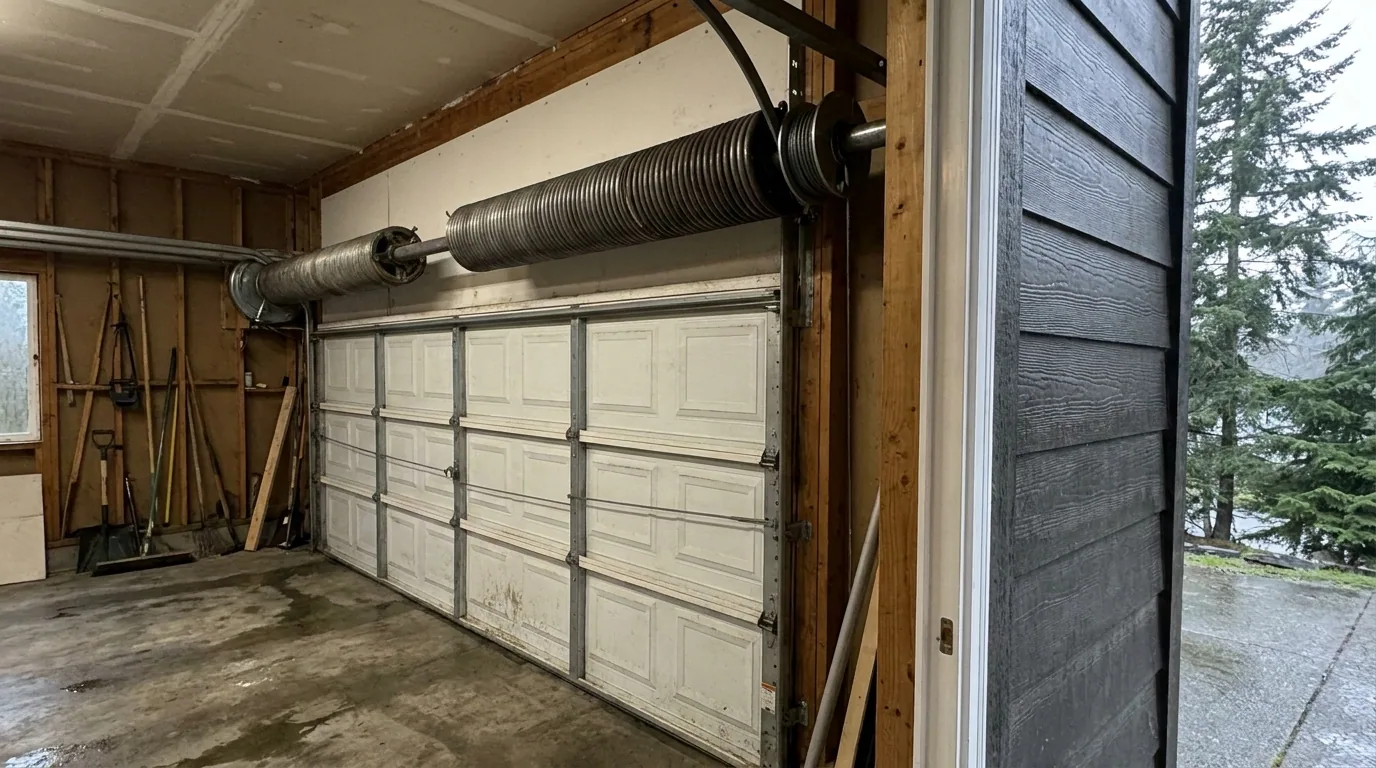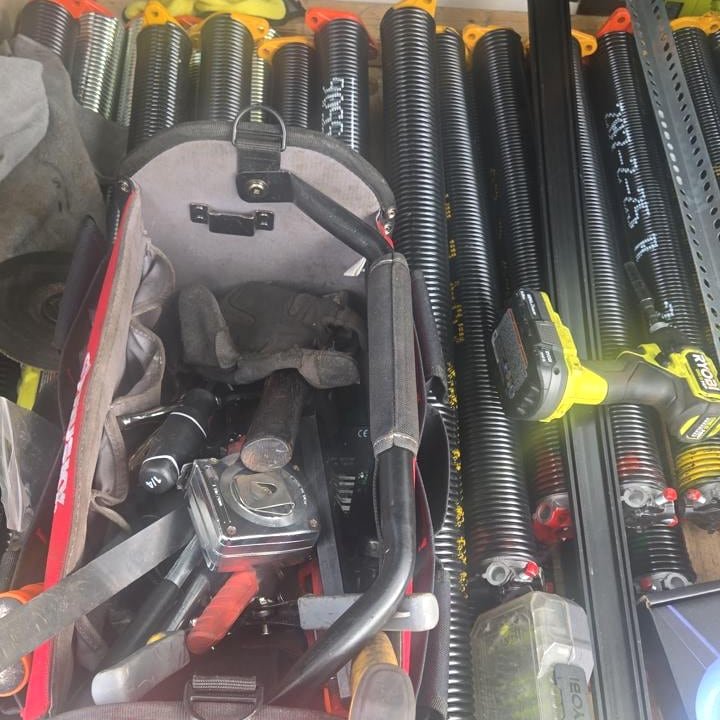
A garage door that will not open leaves most homeowners with two suspects: the spring above the door or the opener motor on the ceiling. From the driveway the two failures can look alike, but they are different problems with different repairs, and one of them leaves the door unsupported. This article explains how to narrow it down using what you can see and hear from outside the door with the garage empty, and where the diagnosis has to stop and a technician take over. It applies to the sectional doors on newer buildings around San Francisco and to the tilt-up and single-panel doors still on many older ones.
Separate the two failures by what the opener does
The first question is whether the opener motor runs at all. That one observation splits the diagnosis in half, and you can make it without touching any moving part.
- The motor runs, but the door does not move. The unit has power and the motor is turning. The fault is somewhere between the motor and the door.
- Nothing happens at all. No motor sound, no light, no click. That points toward power, the wall button, the safety circuit, or the logic board rather than the spring.
- A hum or growl that stops after a second or two. The motor is trying to turn and being resisted. That can be a mechanical bind, a failed gear inside the unit, or a door that has become too heavy for it to lift.
A silent opener is not a spring problem. A running opener that moves nothing is usually not an electrical problem. Everything below follows from which of those you have.
When the motor runs but the door stays put
If the motor runs and the door does not move, there are three likely causes, and the position of the door is what separates them.
A stripped gear inside the opener is one. The motor spins freely, the trolley never travels, and the sound is often a whir with no movement of the chain or belt. A snapped cable is another: a door with a snapped cable hangs at an angle rather than sitting level, and the opener may run briefly before resistance stops it. A broken torsion spring is a third. A torsion spring that has broken cannot hold the door's weight, so the door becomes far too heavy for the opener to lift, and the motor may strain, hum, and shut off.
So: if the door sits crooked in the opening, with one side lower than the other, the cable is the leading suspect. If the door sits level but has become noticeably heavier in normal use, the spring is the leading suspect. If the door sits level, feels as it always has, and the opener simply whirs without the trolley moving, the gear inside the unit is the leading suspect. None of these is confirmed until a technician has inspected the springs, cables, and drive train.
When the opener is silent
A completely silent opener sends you in a different direction. Check the obvious first: the breaker, the outlet the unit is plugged into, and whether the wall button has a light. If the unit has no power at all, nothing else can be diagnosed until that is restored.
If the unit has power and its light comes on but the door does not move, the safety circuit is worth considering, with one important limit. A blocked or misaligned photo-eye reverses a door that is closing, and only while it is closing. It is a safety device on the down travel. It has no role in a door that will not start at all, so do not assume the eyes are the answer to a door that never begins to move. A silent unit with power is more often a wall button, a wiring connection, or the logic board, and those are technician work.
What you can safely observe, and what you cannot
With the garage empty and the door closed, you can look at the door from outside and note a few things: whether it sits level in the opening, whether there is a gap along the top, whether it has become noticeably heavier in normal use, and whether it makes a new noise at the start of a cycle. Those observations are useful, and they are safe.
Everything above the door is not. Torsion springs, cables, and the opener drive train are under tension and are not homeowner territory. Do not reach up to examine the spring, do not try to lift the door to judge its weight, and do not pull the emergency release and move the door yourself. A door that has lost spring tension can come down hard, and a cable under load can do serious damage. A technician inspects and adjusts those parts.
Why the distinction matters
Getting the diagnosis right the first time saves a second visit and prevents the wrong part being replaced. A door that will not lift because of a broken spring will not be fixed by a new opener, and a stripped gear will not be fixed by a new spring. The two failures also carry different safety implications: a spring failure leaves the door unsupported, while an opener failure usually leaves the door where it is.
If you have narrowed it down and are still unsure, describe what you heard and what the door is doing when you call. Same Day Garage Door Repair & Service works on residential and commercial doors across San Francisco, including the Mission District, Castro, Noe Valley, Pacific Heights, SoMa, Richmond District, Sunset District, Bernal Heights, Glen Park, Marina District, North Beach, Hayes Valley, Potrero Hill, and Excelsior District. The company is licensed and insured, reachable at (415) 992-9484 or SameDayGarageDoorOne@gmail.com, and offers 24/7 emergency service alongside weekday hours of 7:00 AM to 8:00 PM and weekend hours of 8:00 AM to 6:00 PM. A technician can confirm whether the spring, the cable, the opener, or something else is at fault before any work begins.