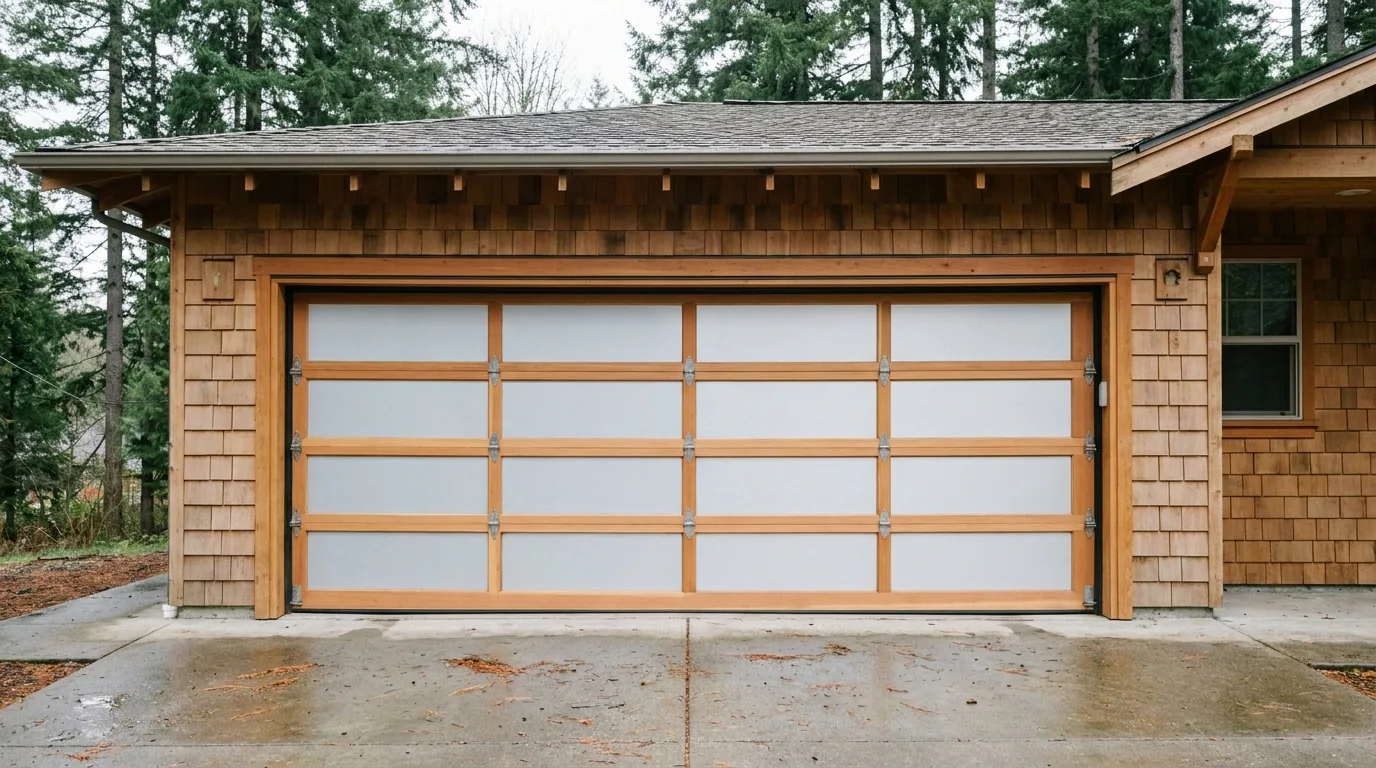
A single-panel timber door that sags at one or both corners is a common sight on older San Francisco buildings, and it is usually an adjustment problem rather than a replacement problem. The door is a frame of stiles and rails with a skin or planks over it, hung on hinges at the jambs, and often stiffened by a diagonal or horizontal brace on the inside face. When a corner drops, the cause is almost always in the hinge side or the bracing, not in the panels themselves. This article covers what you can safely observe from outside the door with the garage empty, the most likely causes of a sagging corner, and which adjustments belong to a technician. Same Day Garage Door Repair & Service works on residential and commercial doors throughout San Francisco, including the Mission District, Noe Valley, Bernal Heights, and Glen Park.
Start with where the door sits in the opening
Stand outside the door with the garage empty and look at the gap between the door and the jambs and header. Note three things: whether the gap is even along the top, whether one corner sits lower than the other when the door is closed, and whether the door rubs or catches at the same point every time it moves. A door that is square in the opening but sags only when open points to the hinges and the brace. A door that sits crooked even when closed may have a hinge problem, a brace problem, or a track and jamb problem. The pattern narrows the list before anyone touches a tool.
The hinge side carries the weight
On a single-panel door, the hinges do more than pivot the door. They carry its weight, and on an older timber door the hinge leaves and the screws that hold them can work loose over years of cycling. A top hinge that has pulled slightly from the jamb lets that corner drop. A bottom hinge that has worn lets the door hang. The result is a corner that sags and a door that rubs at the opposite jamb. The technician checks the hinge leaves, the screws, and the jamb material behind them, because on older buildings the jamb itself may be soft or split and a longer fastener or a repair plate may be needed. Do not tighten or replace hinges yourself; the door's weight is on them, and a door that comes off its hinges is a hazard.
The brace holds the frame square
Most single-panel timber doors have a diagonal or horizontal brace on the inside face, and its job is to keep the door frame square. When the brace fasteners loosen, or the brace itself has shrunk or cracked, the door can rack out of square and a corner drops. The technician checks the brace for movement, loose fasteners, and cracks, and adjusts or refastens it as needed. This is not work for a homeowner: the brace is structural to the door, and a door that racks while someone is working on it can bind or fall. What you can do is note whether the sag appears at the same corner every time and whether the door feels heavier or harder to move than it used to.
When the cause is not the hinge or the brace
A sagging corner can also come from a jamb that has moved, a track that is out of line on a door that rides one, or a header that has settled. On pre-1970 buildings the garage opening often carries structural load, so a jamb or header that has moved is worth a careful look before anyone drills. The technician checks the jambs for plumb and the header for movement, and if the opening itself has shifted, the repair may need to address that before the door is adjusted. This is why a sag that returns after an adjustment is worth investigating rather than adjusting again.
What the technician does
The technician inspects the hinges, the brace, the jambs, and the header, and adjusts the door so it sits square in the opening and travels without rubbing. That may mean refastening a hinge, repairing a brace, shimming a jamb, or adjusting the track on a door that has one. The technician also checks the springs and cables while the door is open, because a door that has been sagging can put uneven load on them. None of that work belongs to a homeowner: the springs are under tension, the cables are under load, and the door's weight is on the hinges. If a corner is sagging, the safe move is to stop cycling the door and have it looked at.
If your single-panel door is sagging at a corner, Same Day Garage Door Repair & Service can inspect the hinges, brace, and opening and adjust the door so it sits square. Call (415) 992-9484 or email SameDayGarageDoorOne@gmail.com. The business is licensed and insured and serves San Francisco, including the Mission District, Castro, Noe Valley, Pacific Heights, SoMa, Richmond District, Sunset District, Bernal Heights, Glen Park, Marina District, North Beach, Hayes Valley, Potrero Hill, and Excelsior District.