A sectional door that binds at the same panel on every cycle is giving you a repeatable clue. The door travels freely through most of its run, then hesitates, catches, or jumps at one consistent point. That pattern matters more than the sound itself, because a bind tied to a single panel narrows the list of suspects considerably. In a Marina District building, where fog and salt air work on exposed steel year-round, the parts most likely to be involved are the rollers, the hinges that carry them, and the track those rollers ride in. This article covers what you can safely observe from outside the door with the garage empty, what the rollers are actually doing as the door passes that panel, and which work belongs to a technician. Same Day Garage Door Repair & Service works on residential and commercial doors throughout San Francisco, including the Marina District.
Start with where in the cycle the bind happens
Stand outside the door with the garage empty and watch a full open and a full close. You are listening and watching for the moment the door hesitates. Note three things: whether the bind happens at the same panel height every time, whether it happens on the way up, the way down, or both, and whether the door makes a single hard catch or a series of small stutters as it passes.
That timing tells you a lot. A bind that occurs at the same height in both directions points toward something fixed in space — a section of track, a hinge, or a roller that has to pass through a tight spot. A bind that only happens on the way down, or only on the way up, can point toward the opener's force settings or the door's travel limits rather than the hardware itself. A stutter that repeats several times as one panel passes suggests a roller that is dragging rather than a single obstruction.
What the rollers do at a panel
Each roller sits on a stem mounted to a hinge, and the roller rides inside the track. As the door moves, the roller rotates and the stem pivots slightly in the hinge. When everything is aligned, the roller rolls. When it is not, the roller can stop rotating and start sliding, and a sliding roller drags against the track instead of rolling through it.
There are several reasons a roller at one panel would stop rolling. The roller's bearing can seize, particularly on a door exposed to salt air, where corrosion works on the steel fastest. The hinge can bend or loosen so the roller sits at an angle in the track. The track itself can be dented, out of plumb, or pushed slightly out of line at that height. A roller can also be the wrong size or worn enough that it no longer fills the track properly. None of these can be confirmed from outside the door — a technician checks the rollers, the hinges, and the track directly. What you can note is whether the bind is a hard catch or a soft drag, and whether it happens at the same height in both directions.
What you can see from outside the door
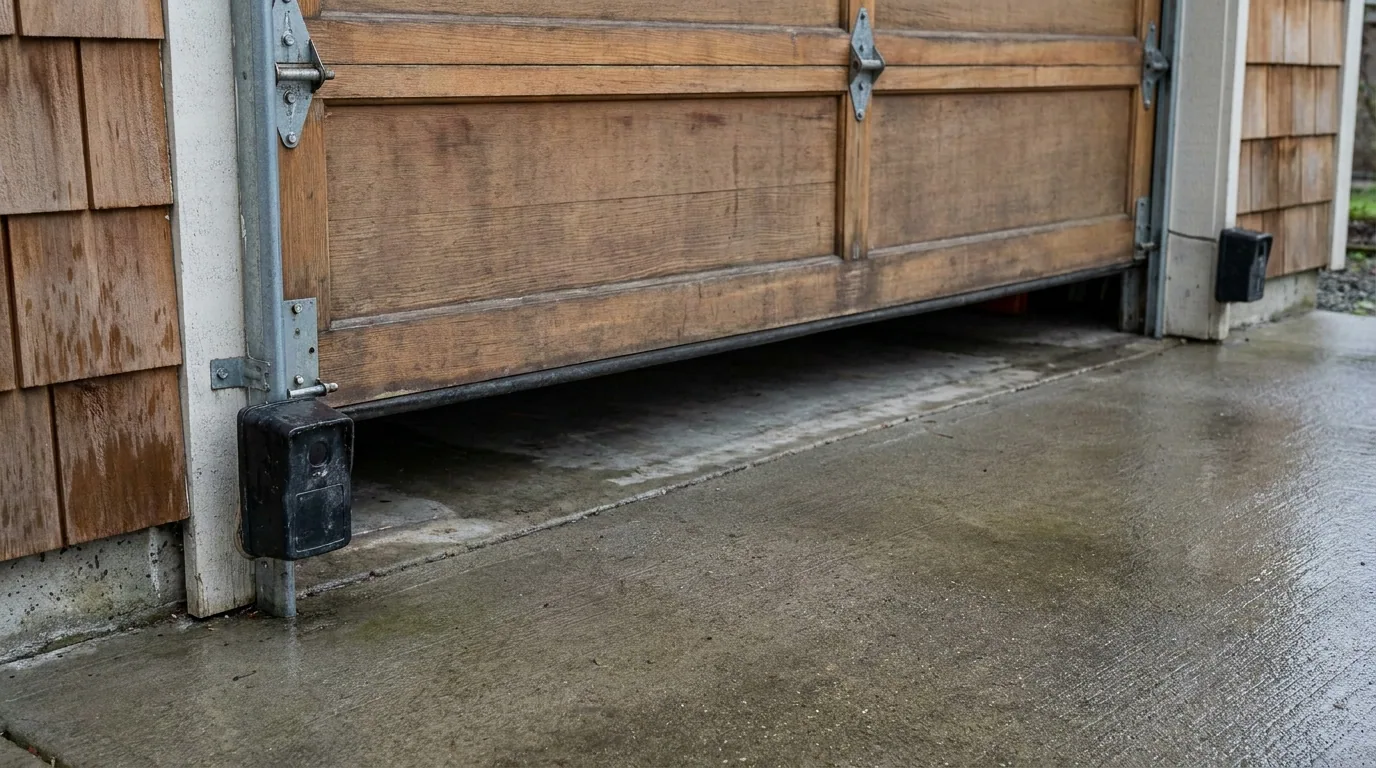
With the garage empty and the door closed, look at the door as a whole. A door that sits crooked in the opening, with one side higher than the other, is worth noting. A visible gap along the top of the door when it is closed is worth noting. A door that feels heavier than usual in normal use — not something you test by lifting, but something you notice when you open it with the opener — is worth noting. These observations help a technician before anyone arrives.
Do not reach for the rollers, hinges, or track yourself. Do not pull the emergency release and move the door by hand, and do not try to test the door's balance. Those are technician work. The door's springs and cables carry the door's weight, and the opener's drive train is under tension. A technician inspects the springs and cables, checks the rollers and hinges, and confirms the track alignment.
Why the Marina District puts extra load on these parts
Salt air and fog are hard on exposed steel. In the Marina District, a door that faces the weather can show corrosion on rollers, hinges, and track faster than a door in a sheltered interior. That does not mean every bind is corrosion, and it does not mean a corroded part is the cause until a technician confirms it. It does mean that when a bind appears at one panel, the rollers and hinges at that panel are worth having checked rather than assumed to be fine.
A bind that appears only in damp weather, or only in the morning, has several possible causes. It could be a roller that is dragging, a hinge that has loosened, or a track that has shifted. The way to separate them is for a technician to inspect the hardware at that panel directly. Do not assume one cause because the timing seems to fit.
When to call a technician
A bind that repeats at the same panel is not something to work around. A door that catches can put strain on the opener, the springs, and the cables, and a roller that has stopped rolling can wear the track. If the door hesitates at one panel, if it sits crooked, if there is a gap along the top, or if it feels heavier in normal use, have a technician look at it. Same Day Garage Door Repair & Service is licensed and insured and works on residential and commercial doors throughout San Francisco, including the Marina District. You can reach the company at (415) 992-9484 or SameDayGarageDoorOne@gmail.com.