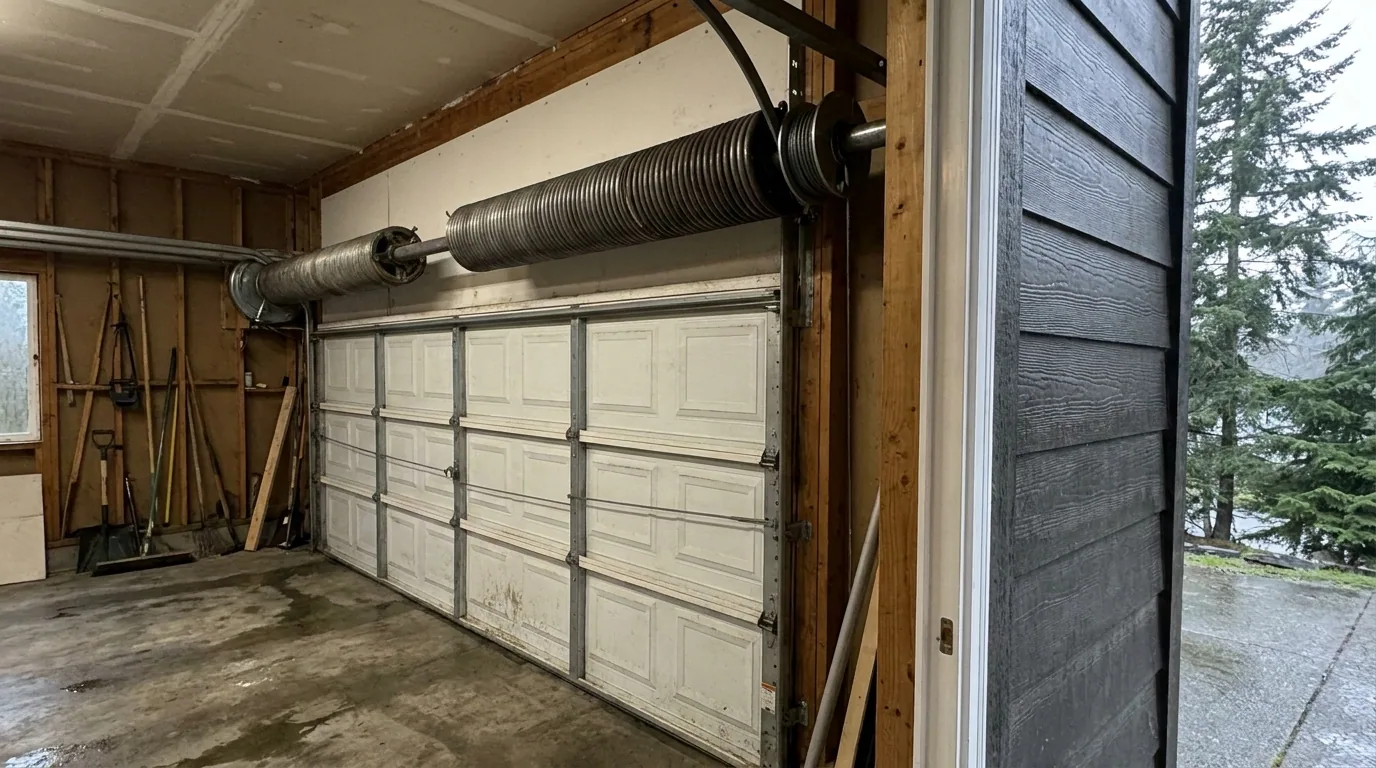
A garage door on a steep driveway has less margin for error than one on a flat slab. The door's travel is set to a fixed point, the opener's force setting is tuned to a normal load, and the safety eyes are aimed across an opening whose floor may not be level. When any of those three drifts, the symptom shows up the same way: the door comes down, stops short of the floor, or reverses before it gets there. On a sloped apron the gap is often at one corner rather than across the whole width, which makes it easy to misread as a track problem. This article covers what you can safely observe from outside the door with the garage empty, the most likely causes, and which adjustments belong to a technician.
Start with where the door stops, not just that it stops
"Won't close flush" covers several different behaviors, and the pattern narrows the list considerably. Watch a full cycle from outside the door and note three things: how far down the door travels before it reverses, whether the reversal happens at the same point every time, and whether the bottom edge is level with the floor or high at one corner.
A door that reverses a few inches above the floor, consistently, is behaving differently from one that touches down and then goes back up. A door that stops short at one corner only is different again from one that stops short evenly across the opening. Each pattern points toward a different part of the system, and a technician will ask you which one you saw.
Travel limits and force settings
The opener has two settings that govern the down cycle. The travel limit tells the motor where the closed position is. The force setting tells it how much resistance to tolerate before it treats the resistance as an obstruction and reverses.
A door that stops a few inches short on every cycle, in the same place, is consistent with a travel limit that has moved or was never set correctly for the door. A door that reaches the floor and then reverses is more consistent with a force setting that is too sensitive, or with something in the door's path adding resistance near the bottom. On a steep apron, the door's bottom edge can meet the floor at a slight angle, and that contact can register as resistance.
Neither setting is something to adjust by trial and error from the ground. The force setting in particular is a safety adjustment: set too high, it lets the door keep pushing against an obstruction. A technician sets both against the door's actual travel and weight.
What the photo-eye does and does not do
The safety eyes mounted at the bottom of the tracks are a reversing device for the closing direction only. If the beam between them is blocked or the two units are out of line with each other, a door that is on its way down will reverse. That is the whole of their job.
They have no role in a door that will not start at all, and no role in a door that opens a little and then reverses on the way up. If your door reverses before it reaches the floor, the photo-eye is not the first thing to suspect — that pattern belongs to the travel limit or force setting discussed above. On a sloped apron, the eyes can also be knocked out of alignment by the door's bottom section if the track sits low, or by a car bumper, a bike, or a stored item that has shifted into the beam. Keeping the area around the eyes clear is something any homeowner can do.
Why a sloped apron makes the gap worse
A driveway that falls away from the garage means the door's bottom edge meets a surface that is not parallel to the header. The door can be perfectly square and still leave a wedge-shaped gap at one corner, because the floor beneath it slopes. That is a geometry problem, not necessarily a fault.
What matters is whether the gap has changed. A door that has always sat slightly proud at one corner on a steep driveway is one thing. A door that used to close flush and now does not is telling you something has moved — the travel limit, the track, a hinge, or the door's own alignment. The observation is the same either way: watch the bottom edge as it comes down and note whether the gap is new.
What to check from outside the door
With the garage empty and the door closed, a few things are safe to look at without touching the hardware:
- Whether the bottom edge sits parallel to the floor or high at one corner.
- Whether anything is stored near the photo-eyes or leaning into the beam path.
- Whether the door sounds different at the start of a cycle than it used to — a new grind or pop is worth mentioning when you call.
- Whether the door feels heavier than usual in normal use.
Anything involving the springs, the cables, the track alignment, or the opener's internal settings belongs to a technician. Those parts carry the door's weight and store energy, and adjusting them without the right tools and knowledge is how people get hurt.
If your door is stopping short or reversing on a steep San Francisco driveway, Same Day Garage Door Repair & Service works across the Mission District, Castro, Noe Valley, Pacific Heights, SoMa, Richmond District, Sunset District, Bernal Heights, Glen Park, Marina District, North Beach, Hayes Valley, Potrero Hill, and Excelsior District. The company is licensed and insured and can be reached at (415) 992-9484 or SameDayGarageDoorOne@gmail.com. Emergency service is available around the clock, and regular hours are Monday through Friday 7:00 AM to 8:00 PM and Saturday and Sunday 8:00 AM to 6:00 PM.