An opener that sounds loud in the garage is one thing. An opener whose noise arrives in the flat above, or in the bedroom of the unit next door, is a different problem, and in a shared Victorian or Edwardian building it is usually the complaint that matters. The motor, the rail it rides on, and the door it lifts are all bolted to a building that carries sound well. A chain drive and a belt drive sound different from each other, and the same opener can sound different in the garage than it does two floors up. This article covers what you can safely observe from outside the door with the garage empty, how to tell an opener noise from a door noise, and which work belongs to a technician. Same Day Garage Door Repair & Service works on residential and commercial doors throughout San Francisco, including the Mission District, Noe Valley, Hayes Valley, and Pacific Heights.
Start with when the noise happens in the cycle
Stand outside the door with the garage empty and listen to a full open and a full close. Note three things: whether the noise starts the moment the motor engages or only once the door is moving, whether it is steady through the whole run or comes and goes at one point, and whether it stops when the door stops but the motor is still running. That last detail separates a motor-and-rail problem from a door problem. A motor that runs without the door moving points to the drive train, and that is technician work. A noise that only appears while the door is travelling is more likely to involve the door itself, its rollers, or its hinges.
Separating opener noise from door noise
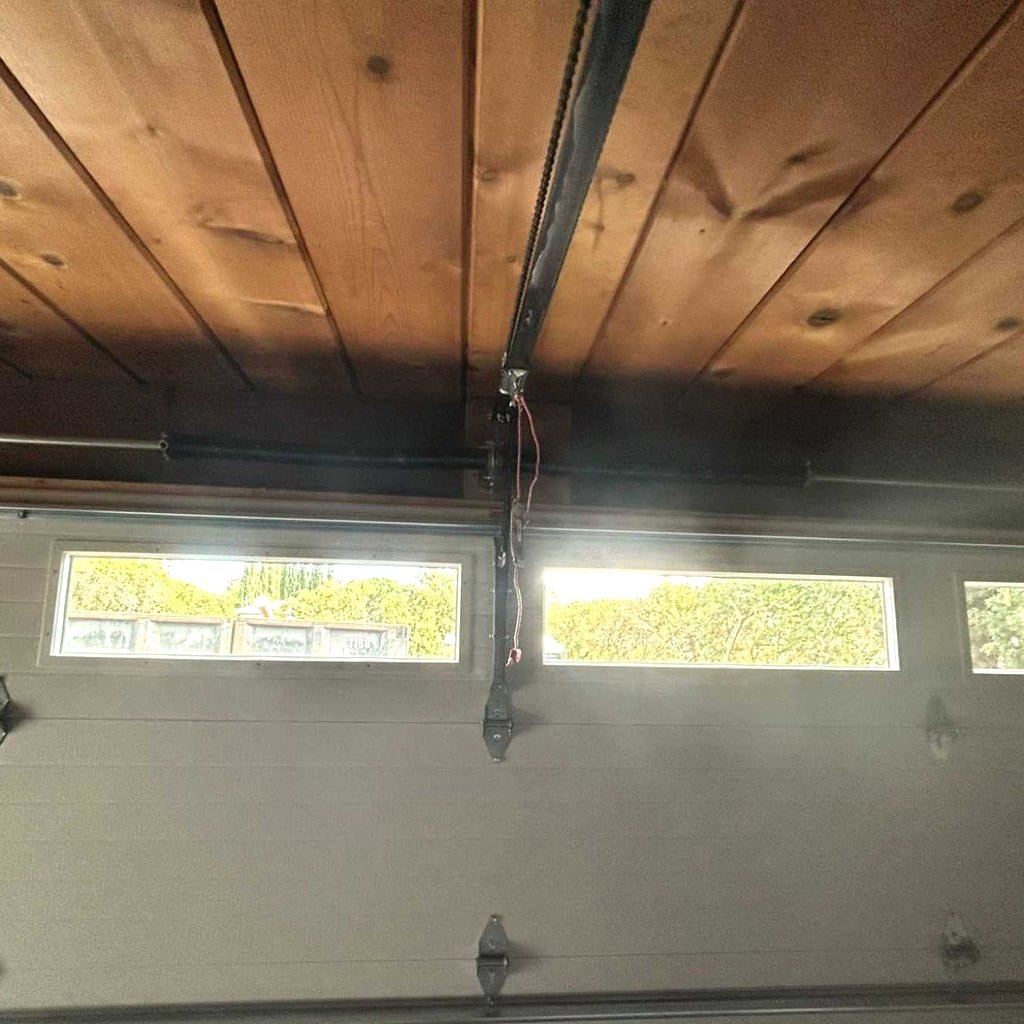
An opener is a motor, a rail, and a carriage that pulls the door. A door is panels, rollers, hinges, tracks, springs, and cables. Both are attached to the same structure, and both can produce a rattle, a hum, or a squeal that reaches the flat above. The useful question is which one is making it.
- A steady mechanical hum that begins the instant the motor starts and continues at constant pitch is characteristic of the motor and its drive. It is the sound of the unit itself rather than the door.
- A rattle or clatter that rises and falls with door speed tends to follow the door's moving parts: rollers in the track, hinges between panels, or a panel that is loose on its hardware.
- A single knock or bang at the start of the cycle is a start-of-travel event. It can come from the opener's carriage taking up slack, from a roller seating in the track, or from the door settling against the header, and those are separated by watching where the door is when the sound occurs.
- A squeal that appears partway through the run has several possible sources, among them a dry roller, a hinge, or a bearing. A technician isolates it by lubricating and testing one component at a time.
None of these observations require you to touch the opener's drive train, the springs, or the cables. Watching and listening from outside the door with the garage empty is enough to narrow the list before anyone arrives.
Why chain and belt drives carry differently
A chain drive moves the carriage with a metal chain running over a sprocket, and a belt drive uses a reinforced belt. The two produce different sounds, and owners often describe the chain as the louder of the two. What matters for a shared building is not only the sound in the garage but how it reaches the rooms above. The opener hangs from the ceiling structure, and the rail runs back to the header above the door. Both are hard connections to the building. Sound and vibration travel along those connections into the framing and then into the floors and walls of the flats. A quieter drive unit helps, but the mounting is often as important as the drive type, and mounting changes belong to a technician.
What a technician can adjust
Once the source is narrowed, the work itself is straightforward for someone with the right tools. A technician can check the drive chain or belt for correct tension, since an over-tight or slack drive changes both the sound and the load on the motor. They can check the mounting brackets and the header connection for looseness, and they can confirm whether the rail is properly supported along its length. They can also inspect the door's rollers, hinges, and track, because a door that binds or rattles adds its own noise to the opener's. On older buildings, the garage opening often carries structural load, so any work around the header and track deserves a careful look before anything is drilled or re-anchored. The technician inspects the springs and cables as part of the same visit.
What you can check without tools
There is a short list of things a homeowner or landlord can safely note before calling. Watch whether the noise is worse on the open or the close. Note whether it changes when the weather changes, without assuming a cause. Check that nothing stored in the garage is resting against the door or the track, since a leaning box or a bicycle against a panel will rattle with every cycle. Confirm whether the noise is present in the garage only or also in the rooms above, and at what point in the cycle it arrives upstairs. Those notes shorten the diagnosis. Anything involving the springs, the cables, the opener's drive train, or the door's balance is technician work, and should be left alone.
If the noise has become a recurring complaint in a shared building, it is worth having the opener and the door looked at together rather than treating them as separate problems. Same Day Garage Door Repair & Service is licensed and insured and can be reached at (415) 992-9484 or SameDayGarageDoorOne@gmail.com. The address is 328 Bocana St, San Francisco, CA 94110, with weekday hours of 7:00 AM to 8:00 PM, weekend hours of 8:00 AM to 6:00 PM, and 24/7 emergency service.